



How the Taylorist view of humanity of the “homo oeconomicus” stands in the way of joint value creation
The premises underlying our decisions significantly shape our behavior. If we trace the origins of our decision premises, we inevitably encounter Taylorism, which continues to influence our thinking and actions as well as the structures of our entire economy to this day.
As a “system of scientific management with the aim of achieving the most economical operational process possible,” Taylorism has spread widely since its emergence in 1910. The separation of thinking and doing led to enormous efficiency gains in the environment of that time and thus to increases in productivity and prosperity that had previously been unimaginable.
In today’s dynamic, complex, and highly competitive environment, however, Taylorism has become synonymous with unused intelligence and suppressed creativity. On closer inspection, it increasingly reveals itself as a cause of inefficiency and poor decisions. In this article, we will take a closer look.
Taylorism as the cornerstone of the management function
Around 1900, engineer Frederick Winslow Taylor developed a concept for modernizing industrial work processes. Taylor introduced management as a function for the first time by reserving planning for management and leaving execution to the workers. He differentiated between:
- the leadership competencies to be exercised by management, and
- the execution competencies assigned to operational employees.
From these considerations within an industrial environment, management theory emerged as a sub-discipline of business administration, with the goal of making value creation more efficient.
With the onset of globalization and advancing industrialization, predominantly local businesses were challenged to work more efficiently in order to compete in broader, more competitive markets.
At the same time, an increasingly consumption-oriented society developed, demanding high-quality products at affordable prices. For a long time, companies responded with efficiency gains. Taylorism aimed to generate these gains through the separation of intellectually demanding work from simple manual tasks. It assumed that pronounced differentiation and vertical division of labor could significantly increase productivity.
From Taylorism to the network economy
Market liberalization at the end of the 1970s led to the dissolution of traditional production sites. The mass spread of digital technologies and global networking opportunities through the development of the internet created new opportunities and risks and drastically transformed the global economy. Product cycles were shortened and markets became denser again—with one crucial difference: global rather than local competition.
Under these conditions, being faster or cheaper (= more efficient) is increasingly insufficient to remain successful.
It must therefore be about quality, which can only be sustained through innovation.
Yet it can be observed that “more of the same” still defines the direction, even though increasingly negative effects can be seen among individuals, organizations, and in our environment.
In organizations, this manifests primarily as disinterest and a lack of understanding for the final result (for the customer), as well as declining motivation and proactive participation in value creation. On an individual level, negative feedback effects become visible in education and in physical, mental, and social health.
Crises are symptoms that highlight the necessity of overcoming the system. Our management systems are gradually reaching their limits because the underlying view of humanity and resulting leadership philosophy no longer meet market demands or customer needs.
In conditions of increasing complexity, it is no longer sufficient to optimize existing systems. The question is what truly advances us in dynamic and complex environments—and how existing structures stand in the way. It is no longer efficiency that matters, but effectiveness.
Economic viability results from effectiveness. Yet today, the one-dimensional focus on economic efficiency often stands in the way of effectiveness in terms of learning capacity, performance, and innovation.
Why is that?
Fundamental assumptions of the Taylorist view of humanity
- People are seen as cheap production factors.
- People have only primary needs.
- People pursue only one goal: satisfying their primary needs to maximize personal utility – the “homo oeconomicus.”
- People are primarily motivated to work by financial incentives.
- People constantly strive to avoid work and withhold performance. Humans are considered an uncertainty factor in mechanized production processes.
- People are neither capable nor willing to plan their work and carry it out rationally. Instead, they must be systematically driven to perform by managers.
- People are willing to restrict themselves to passive behavior and allow themselves to be manipulated, motivated, and controlled by superiors.
- People are willing and able to separate private interests from company interests and treat emotions at the workplace as a private matter.
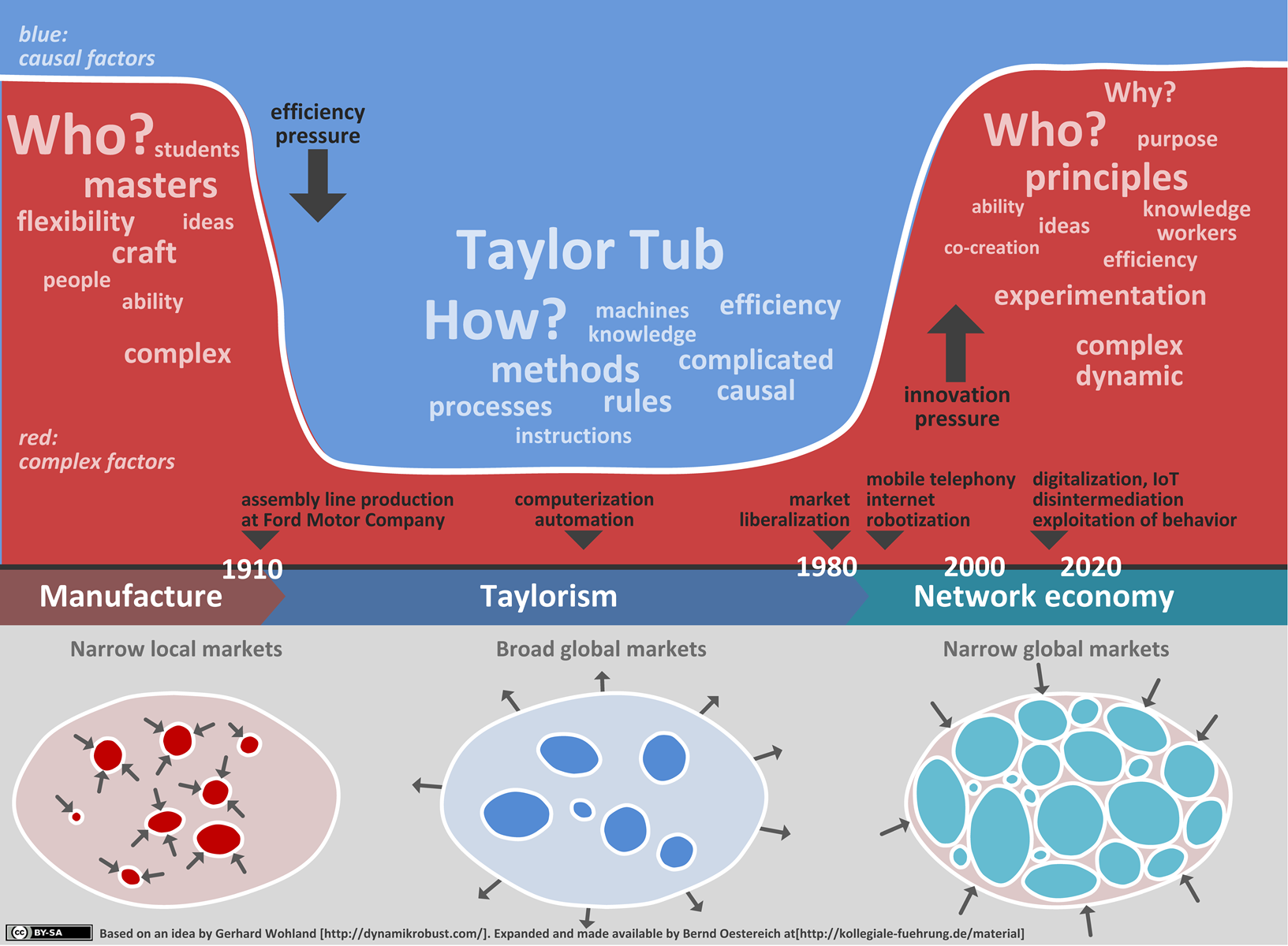
How Taylorism still shapes and obstructs us today
Taylorism, the resulting bureaucratic-hierarchical structures, and their disadvantages are clearly visible today. Although democratic, pluralistic, and autonomous ideas have taken hold in large parts of Western Europe, the spirit of Frederick Taylor remains deeply rooted in our minds. The fact that many have not yet detached themselves from often inhumane leadership and working methods is particularly evident in the “extended workbenches” of the Western world, where division of labor often goes hand in hand with shameless exploitation.
Taylor’s “scientific management” achieved global success because it aligned with the prevailing view of humanity, decision premises, and complexity requirements at the beginning of the 20th century.
Taylorism established a view of humanity in which people, driven by economically defined self-interest, must be externally motivated and controlled. The assumption that people inherently seek to minimize effort while maximizing wages still persists in many minds.
The Taylorist view is also firmly anchored in the Prussian-influenced school system and corresponding higher education structures. This is relevant because a large part of our worldview and view of humanity is shaped there. We are rarely fully aware of these influences. Personal conditioning often hinders entrepreneurs in developing their businesses because the limitations imposed by outdated beliefs remain unrecognized.
Anyone who looks closely will notice that performance assessments and grading systems in schools ensure that everyone sits quietly, follows rules, and does what is prescribed. In such an environment, second-order learning is impossible.
What is the problem with this attitude toward others—and toward ourselves?
- The blanket assumption of egoism and distrust becomes a self-fulfilling prophecy. Those who view others as selfish utility maximizers will eventually behave accordingly.
- The creative potential of people is undermined and systematically suppressed. Those who make people feel they must be controlled and foster fear of mistakes deprive them of the ability and willingness to think independently and contribute meaningfully.
- Collective intelligence remains unused and valuable ideas stay hidden. When people do not dare—or see no purpose—in contributing, questioning, or experimenting, collective intelligence cannot be utilized.
An alternative proposal: the humanistic view of humanity
Taylor viewed organizations as machines whose efficiency depended on how well their parts functioned together. In this model, most people were reduced to cogs—responsible for execution, but not for designing the machine itself. The focus was on system optimization enabled by separating conceptual thinking from manual execution.
Even if this separation is less pronounced today and employee involvement is often discussed, most companies are still far from having structures that truly allow integration, collaboration, and cooperation without disruption.
Most companies continue to centralize decisions with minimal participation. Instead of practicing customer centricity, they rely on instruction and control as guiding principles. They attempt to lead people like sheep who would otherwise be lost—despite the fact that much manual work can now be automated and innovation pressure continues to rise. But where should ideas come from, and how should innovation emerge?
The implicit knowledge and creative potential inherent in employees—unleashed only through collaboration in an enabling environment—are often insufficiently recognized and therefore remain unused.
Here lies the key to (digital) transformation: not the digitization of existing structures, but the unlocking of individual and collective intelligence makes the difference.
Instead of seeing humans as cogs in a machine, we should remember that humans are dynamic and extraordinarily complex organisms whose vitality cannot be stripped away. If we search for what truly binds us together as individuals, organizations, and societies, we quickly encounter very different answers.
“The humanistic view of humanity understands the human being as a relationship-oriented, freedom- and decision-capable, responsible, educable being striving for personal development.”
There is ample evidence that people seek respect, acceptance, community, and shared values. Yet many still assume that personal utility maximization is the primary—perhaps only—human motive. Every man for himself. Tooth for tooth.
For most people, however, “living a meaningful life” is more important than money, power, and status. Rather, we strive for a sense of belonging. This connectedness clearly contradicts the fundamental assumptions underlying Taylorist economic theory.
We propose reflecting on one’s own view of humanity and, if necessary, developing a more comprehensive understanding of the human being in order to …
- renew leadership and management so that self-organization becomes possible.
- design organizations in a people-centered way so that everyone can and wants to contribute to value creation.
- develop customer-centered business and brand strategies through which the right people are reached.