



Understand Correlation and Causation: How to Make Better Decisions as an Entrepreneur
As an entrepreneur, your success ultimately depends on the quality of your decisions. The sum of your decisions determines success or failure. However, we are all subject to cognitive biases.
The complex and dynamic environment and the overwhelming amount of information we are exposed to
(https://www.solvitdigital.team/insights/wie-die-digitalisierung-unsere-kommunikation-und-unser-verhalten-beeinflusst)
make decision-making even more difficult.
One of the most common and dangerous thinking errors is confusing correlation with causation. In this article, you’ll learn how to distinguish between the two and avoid costly misinterpretations.
We Construct the World as We Want It to Be
Every day, we draw conclusions from what we observe. Our brain strives for stability and coherence:
- We observe.
- We explain.
- We evaluate.
This process creates our subjective reality.
These distortions don’t just affect everyday life. They appear in business, media, politics, and even science. Entrepreneurs often base decisions on coincidental patterns that appear meaningful but are not causally connected.
Understanding the difference between correlation and causation is therefore essential for effective decision-making.

What Is Correlation? What Is Causation?
Spurious Causality: “Post hoc, ergo propter hoc”
The Latin phrase means: “After this, therefore because of this.”
Just because Event A happened before Event B does not mean A caused B.
Temporal proximity is not proof of causality.
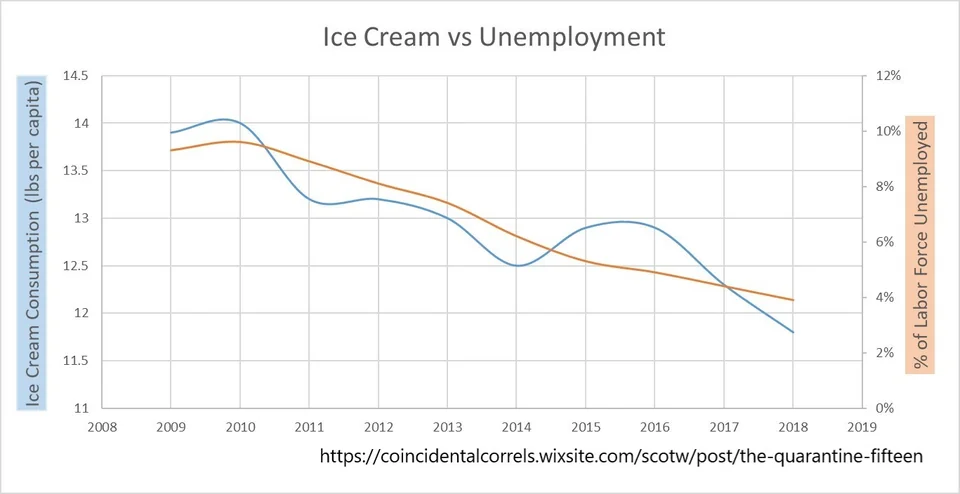
Two Types of Correlation
1. Qualitative Correlation
Two events occur together without one causing the other.
Example: You regularly meet the same person at the supermarket. Neither of you causes the other to shop at that time — you simply share similar routines.
2. Quantitative Correlation
Two variables move together statistically (positive or negative correlation).
If A increases and B increases (or decreases), they are correlated.
But that still does not prove A causes B.
Important: If you analyze enough data, you will always find correlations. Many of them are purely coincidental.
Three Types of Causality
1. Probabilistic Causality
A increases the likelihood of B.
Example: A wet floor increases the probability of slipping — but does not guarantee it.
2. Sufficient Condition
If A occurs, B must occur.
Example: If I leave too late, I will arrive late.
However, arriving late does not necessarily mean I left late. Other factors may be involved.
3. Necessary Condition
Without A, B cannot occur.
Example: Without water, life as we know it on Earth cannot exist.
Why the Distinction Matters
Assuming causality without sufficient proof can lead to disastrous decisions.
In marketing especially —
often described as the realm of digital charlatans
(https://www.solvitdigital.team/insights/marketing-ist-zu-einer-dunklen-kunst-der-digitalen-scharlatane-verkommen)
— correlations are frequently presented as evidence of effectiveness.
More followers do not automatically mean more demand.
More clicks do not necessarily mean more sales.
Data and analytics can help — but they can also reinforce false assumptions.
Healthy skepticism is essential.
How to Approach Causality More Rigorously
Causality is difficult to prove and sometimes impossible to establish conclusively.
Reliable studies require:
- Random selection
- Randomized groups
- Controlled variables
Even then, biases can occur:
- Self-selection bias
- Exclusion of certain demographics
- Behavioral changes due to observation
The way data is collected significantly influences results.
Always question how data was gathered and what assumptions underlie the conclusions.
How to Challenge Causal Claims Yourself
→ Could the relationship be reversed?
Does A cause B — or does B cause A?
Or do both influence each other?
Does social media create successful entrepreneurs?
Or do already successful entrepreneurs perform well on social media because algorithms reward perceived success?
(https://www.solvitdigital.team/insights/marketing-ist-zu-einer-dunklen-kunst-der-digitalen-scharlatane-verkommen)
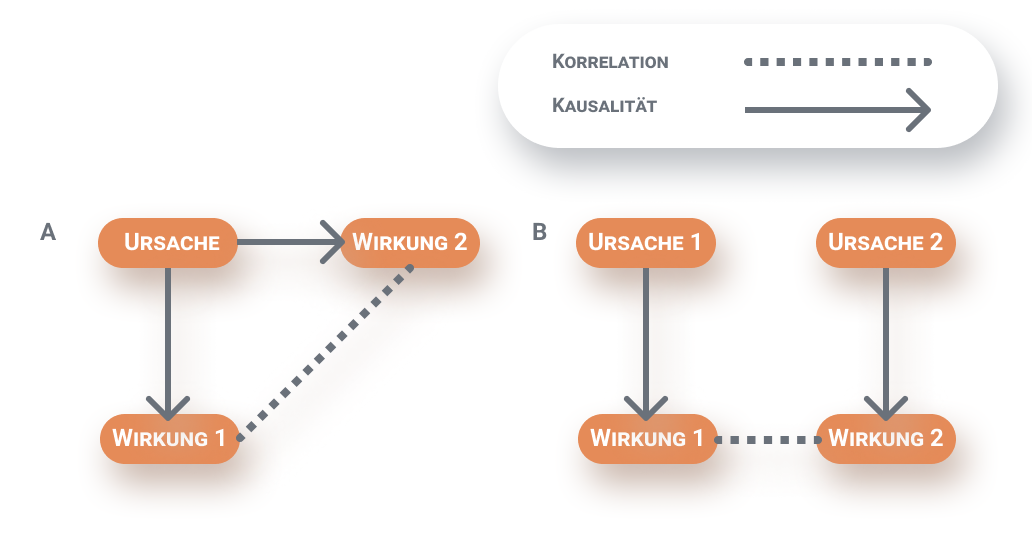
→ Is there a third factor (C)?
A and B may both be effects of another variable.
→ Is there a simpler explanation?
Our perception filters out many influences
(https://www.solvitdigital.team/insights/markenwahrnehmung-wie-du-mit-deiner-marke-im-gedachtnis-bleibst-und-welche-rolle-unsere-sinne-dabei-spielen)
For example, consistently producing high-quality content might correlate with business success — not because of the platform itself, but because it signals discipline, consistency, and long-term thinking.
Final Thought
In an increasingly complex world, mono-causal explanations become less plausible.
Complexity and dynamism continue to increase
(https://www.solvitdigital.team/insights/wie-die-digitalisierung-unsere-kommunikation-und-unser-verhalten-beeinflusst)
That means multiple interacting factors shape outcomes.
As entrepreneurs, we must:
- Make assumptions
- Test them
- Question them
- Refine them
Skepticism protects us from costly mistakes.
Curiosity moves us closer to the truth.
“Through evolution, humans developed a brain capable of creating complex, interconnected systems that they can no longer fully comprehend. To survive as a species, they must nevertheless attempt to understand them.”
– Jürgen Beetz